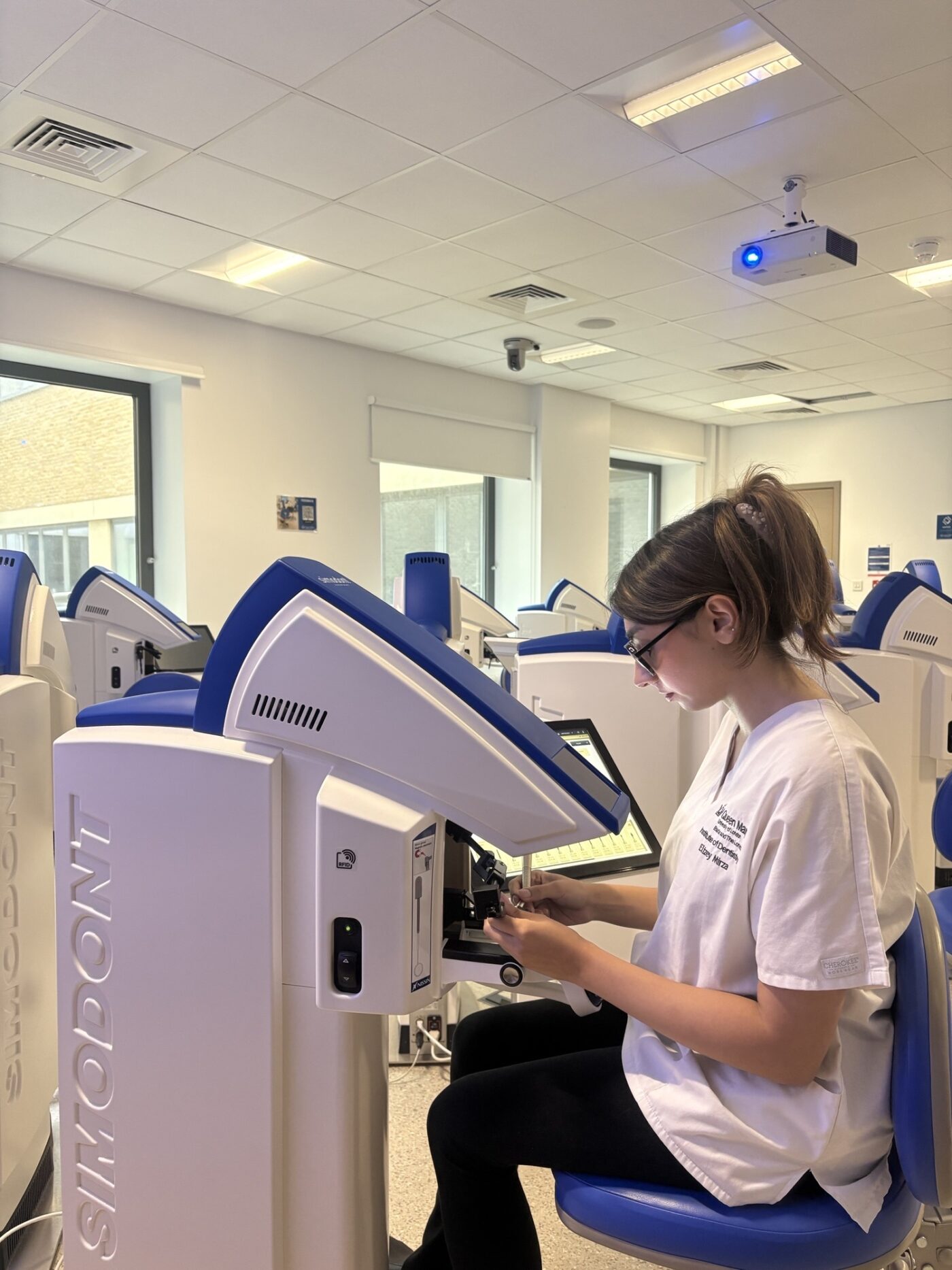
Embedding haptic simulation across the dental curriculum
Haptic simulation has already been integrated into several areas of undergraduate and postgraduate teaching at QMUL. Within undergraduate education, it supports teaching in cariology, paediatric dentistry, periodontology, endodontics and implant dentistry. The technology is also utilised within a range of postgraduate programmes, including specialist training in fixed prosthodontics. Across these disciplines, haptic simulation provides students with additional opportunities to develop technical skills before applying them in clinical practice.
The adoption of haptics across multiple disciplines reflects QMUL’s commitment to innovation in dental education and its willingness to evaluate emerging technologies that can enhance the student learning experience. Importantly, these developments have demonstrated that simulation technologies are most effective when integrated alongside traditional educational approaches rather than used as a replacement for them.
Supporting the development of fixed prosthodontic skills
One area currently attracting particular interest is undergraduate fixed prosthodontics. Developing competence in tooth preparation is a fundamental yet challenging component of restorative dentistry. Students are required to master precise psychomotor skills while simultaneously considering biological, functional and aesthetic principles. As with many clinical procedures, confidence and competence are built through repeated practice and constructive feedback.
Targeted practice to support student progression
Building upon QMUL’s established experience with haptic simulation, planning is underway to further develop its role within the undergraduate fixed prosthodontics curriculum. A key priority is targeted support for students experiencing difficulties during the course or preparing for gateway assessments. Proposed exercises focus on specific preparation skills, including breaking proximal contacts, avoiding excessive tooth reduction, achieving appropriate taper and eliminating undercuts.
Curriculum planning also includes opportunities to practise technically challenging aspects of crown preparation, such as preparing the distopalatal surface of an upper second molar using indirect vision. A further focus is the development of exercises covering different partial-coverage preparation designs, allowing students to explore their features and preparation requirements. The aim is to combine focused haptic practice with tutor feedback and phantom-head teaching, helping students address individual learning needs and build confidence as they progress towards clinical care.
Combining technology with traditional teaching
The future of dental education is unlikely to be defined by technology alone. Rather, it will be shaped by how effectively technology can be integrated into established educational frameworks to support learning and improve patient care. Haptic simulation offers a powerful example of this approach, providing an additional layer of educational support whilst preserving the central importance of traditional teaching, clinical supervision and patient interaction.
QMUL’s experience demonstrates how haptic simulation can be successfully embedded across multiple disciplines while maintaining a strong commitment to educational excellence. As plans progress within undergraduate fixed prosthodontics, the University continues to explore how emerging technologies can enrich learning, support students and help prepare the next generation of dental professionals for contemporary clinical practice.